Available individually
 en
en
 fr
fr
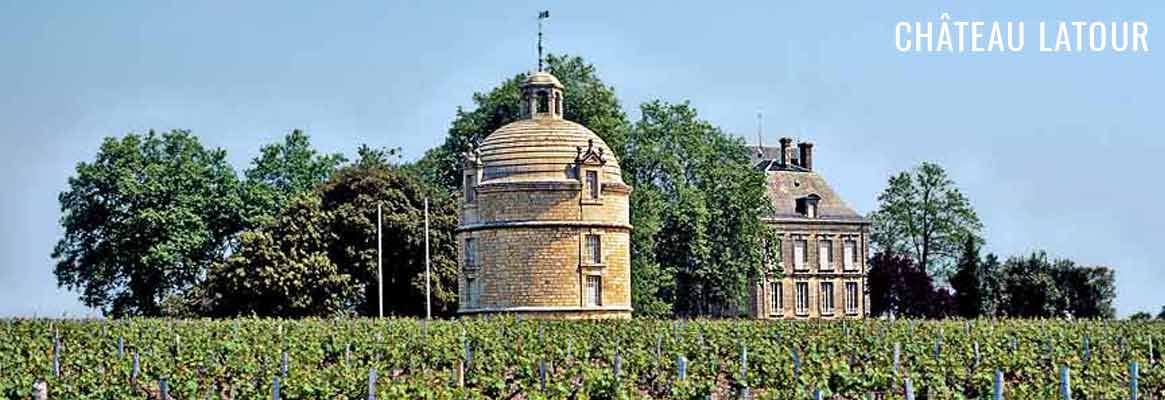
Latour is mentioned for the first time in 1331 when it comes to authorizing the construction of a fortified tower in the parish of Saint-Maubert. This Saint-Maubert tower was used for a very long time as a stronghold to protect the accesses by the estuary and the vineyard was then used to produce wine for the needs of the local community, a wine that had to be drunk during the year....
It was at the end of the 17th century, when the Tower became the property of Alexandre de Ségur, nicknamed the prince of vines by Louis XV, that the great history of Château Latour's wines began. Lovers of wealthy England sought out the great wines of Bordeaux and exports developed. In 1714, Château Latour's wine was worth 4 times more than a regular Bordeaux wine, but it was worth 20 times more 50 years later. The vineyard grew from 38 ha in 1759 to 47 ha in 1794. In the 19th century, successive inheritances pushed the many co-owners, all descendants of the Ségur family, to create a civil company. It lived until 1962, when it was bought by a British financial group and Château Latour remained in the hands of the British (Allied Lyons) for more than 30 years, with only 7% of the shares remaining in the hands of Ségur's heirs. In 1993, François Pinault bought the 93% stake held by Allied Lyons.
Frédéric Engerer became manager of Château Latour in 1998. Since then, major work has been undertaken: total renovation of the cellars, the vat room, the winemaking systems and the storage areas. In the vineyard, respect for the environment prevails: protection of crops by biological means (insect colonization, mating confusion), total absence of chemical weedkiller for soil maintenance, use of organic fertilizers associated with vegetable composts and manure. Biodynamics is being experimented with on about ten hectares of the Enclos.
The vineyard now covers 78 hectares, including 47 hectares around the château, called l'Enclos on the one hand, and about thirty hectares located outside the Enclos and made up of several very beautiful plots whose grapes are used in the blend of the second wine, Les Forts de Latour. The vineyard is made up of approximately 80% Cabernet Sauvignon, 18% Merlot, 2% Cabernet Franc and 2% Petit Verdot. Very poor gravel soils are better suited to Cabernet Sauvignon, whose vines dig deep into the subsoil to find water.
There are 5 products.