Available individually
 en
 fr

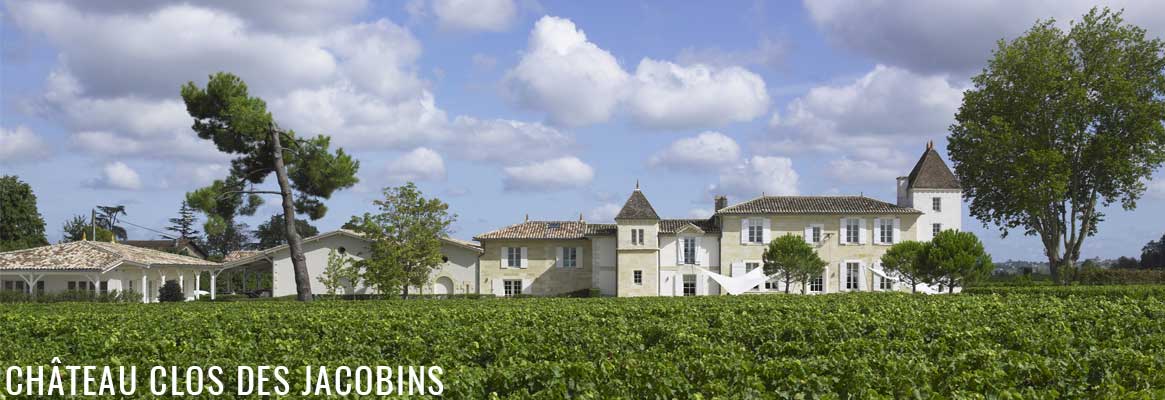
Château Clos des Jacobins is a Bordeaux wine estate in the Saint-Emilion appellation and whose first wine is Grand Cru Classé. The vineyard extends over four types of soil, the limestone rock to the east of the plateau, the clays and sands of the Fronsadais to the south-west, the clays and sands on iron grime at the foot of the hill of Saint-Émilion and the clay-limestone to the north-east of the plateau. In modern times, 75% to 80% of the grape varieties are Merlot, 15% to 20% of Cabernet Franc and, since the 2013 vintage, 2.5% to 7% of Petit Verdot.
The history of the estate dates back to the end of the 14th century when the Jacobin Convent was donated to the Dominican Friars, also known as "Jacobins", whose mission was to accommodate pilgrims travelling the route to Santiago de Compostela. For nearly four centuries, the monks cultivated the vine, even selling their wines as early as the 18th century to the King of England and the King of France. Abandoned by the Dominicans around 1780 and then sold as "national property", it passed successively into the hands of several families.
It was in 1902 that the Jean family became the owners of the estate and it still is today. In 1969, the quality of the wines allowed the Couvent des Jacobins to obtain its first classification as a Grand Cru Classé of Saint-Émilion. Since 2010, Xavier Jean, who represents the 5th generation of the family, has been at the head of the estate.
The estate is currently in the process of converting to organic farming but the cultivation practices have always been very healthy: the vines of the Couvent des Jacobins have been ploughed for several centuries, their high age gives naturally limited yields, the plot monitoring is very rigorous and the harvest is manual. Vinification is carried out on a parcel and intra-plot basis, at a rate of less than 1 hectare per vat. The Petit-Verdot is bred apart. The Château produces a second wine, the Menut des Jacobins.
There is 1 product.