

PREMIUM GERMAN AND AUSTRIAN WINES - PRÄDIKATSWEINE
Prädikatsweine refers to German and Austrian wines of superior quality. They are classified according to the Oechsle scale (Oechsle degree, abbreviated as °Oe), a unit of measurement of the density and sugar content of the grape must before fermentation, the alcohol content. For all Prädikatsweine, it is strictly forbidden to add sugar to the must to increase the alcohol content (chaptalization). The main grape varieties are Riesling, especially in Germany in the regions of Moselle, Rheingau and Nahe), Weissburgunder (Pinot Blanc) and Müller-Thurgau.
1. Kabinett or Kabinettwein
These wines offer a degree of maturity (Mostgewicht) with a must density between 67° and 73° Oechsle, depending on the region and the grape variety, and up to 85° Oechsle in Baden, and a generally quite low alcohol content, between 8% and 11%. The dry (trocken) or semi-dry (restsüß) wines are rather light and fresh, with a nice acid-sweetness tension. The term comes from the word Kabinettskeller designating the freshest and most precious part of the cellar of the Kloster Eberbach around the year 1500, where the best barrels of the harvest were stored. It should be noted that in Austria, the term "Kabinett" obeys different rules and designates a wine of superior quality with a protected designation of origin, and not a Prädikat in the strict sense of German law.
2. Spätlese meaning "late harvest"
These wines are made from ripe grapes harvested after the main harvest and offer a degree of maturity designated by the weight of the must (Mostgewicht) between 76° and 95° Oechsle, depending on the region and the grape variety. The wines are more concentrated, more structured and have a more intense and complex aromatic profile than the "Kabinett", either dry (trocken), semi-dry (halbtrocken), or sweet (feinherb or edelsüß). The occasional presence of Botrytis Cinerea (noble rot) possible.
3. Auslese meaning "selected crop"
For these wines, only ripe, golden yellow, hand-picked grapes are used. Unripe or diseased berries should be strictly sorted. The must weight is between 83° and 100° Oe, depending on the growing region and grape variety. During selection, the grapes may already be partially affected by Botrytis Cinerea (noble rot), concentrating the aromas and giving a sweet, honeyed, complex wine style and a high ageing potential. While a few dry wines are produced in Auslese, most are sweet.
4. Beerenauslese (often abbreviated as BA)
These are sweet wines or edelsüß produced from overripe grapes and sorted grain by berry, generally affected by noble rot (Botrytis cinerea). The required must weight is a minimum of 110° Oechsle in Germany and up to 124–125° depending on the region or the rules in Austria and Germany. The wines are very rich and intense, with a sublime balance between sweetness and fruit acidity, especially with the Riesling grape variety, and a cellaring potential of several decades. The harvest is manual with very careful successive sorting and the wines are rare, produced only in favourable vintages.
5. Trockenbeerenauslese (often abbreviated as TBA)
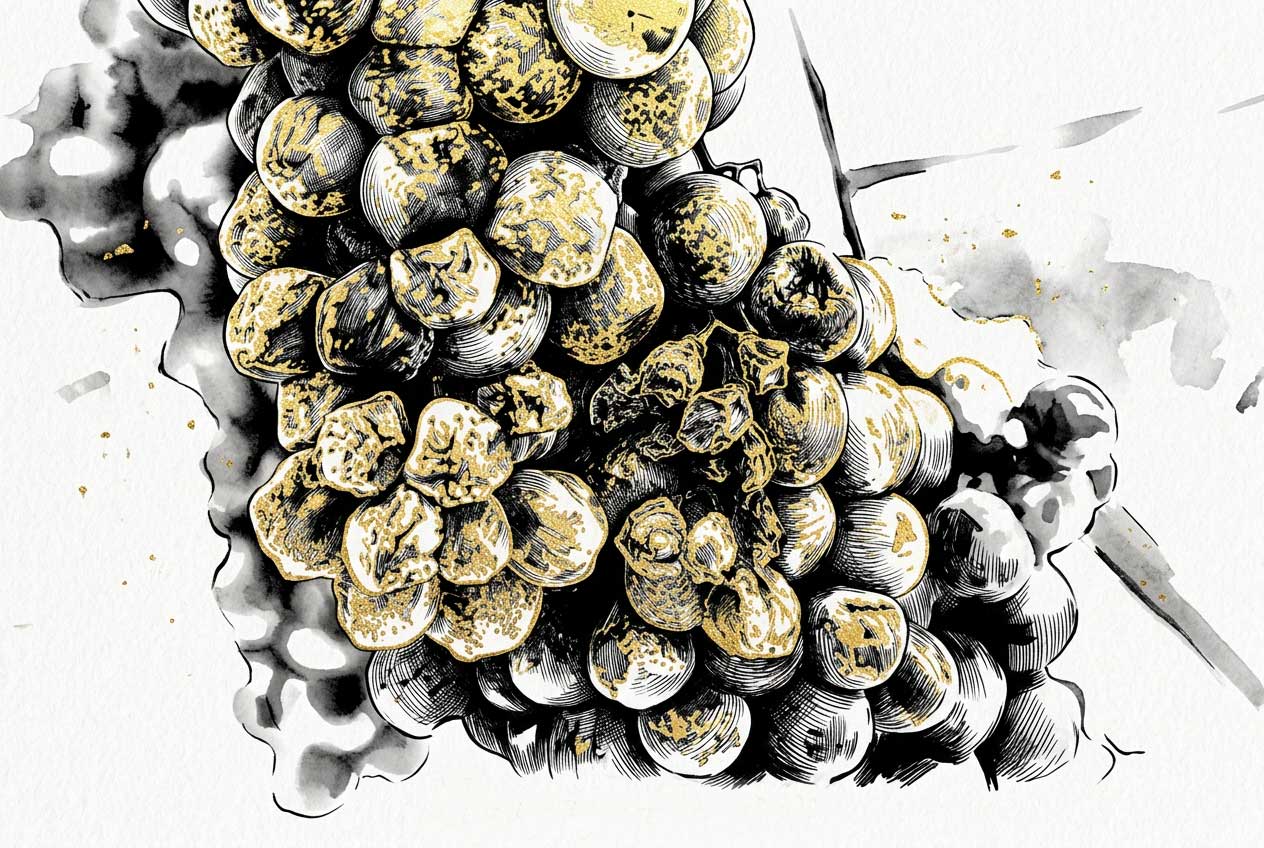
These wines represent the highest quality in the Prädikatsweine pyramid: they are exceptional sweet white wines, of great rarity and with exceptional ageing potential. The grapes are harvested when overripe and are colonised by the fungus Botrytis Cinerea (noble rot) offering extreme concentration. The harvest is carried out exclusively by successive manual sorting, grain by berry, and the yields are extremely low, explaining the high prices of these wines. The must must have a very high concentration of natural sugar between 150 and 160 degrees Oechsle in Germany depending on the region, slowing down alcoholic fermentation and giving wines rich in residual sugar with a low alcohol content, between 5% and 8%. Wines can easily age for several decades and beyond a human lifetime, exceeding a century, developing complex aromas of honey, dried fruit and beeswax.
6. Eiswein designating icewines
These wines accompany the other five possible quality mentions (Prädikate), alongside Kabinett, Spätlese, Auslese, Beerenauslese and Trockenbeerenauslese. The grapes must be harvested and pressed while they are naturally frozen on the vine, at a minimum temperature of -7°C or even lower. The water in the berries remains in the form of ice crystals during pressing, which allows the extraction of a juice that is extremely concentrated in sugar and acidity.